What Are the Benefits of Starting Hospice Earlier?
Starting hospice earlier gives patients and families more time to benefit from everything hospice was designed to provide: nursing care, symptom management, personal care, medications and equipment, emotional and spiritual support, education, and bereavement services. Perhaps even more importantly, earlier hospice gives families something they can never get back later: time.
I know this professionally. Unfortunately, I also know it personally.
My sister was admitted to hospice on the day she died.
I Could See My Sister Declining
Before my sister died, there were signs that her health was changing. She had non-healing wounds on her feet. She was losing weight when she didn't have any weight to lose. She had always been able to walk independently, but she had started using a walker. She seemed to be constantly fighting another cold.
I could see the changes in her face, too. She had always had round cheeks. As she lost weight, those familiar fat pads disappeared. Her face became thinner and more wrinkled, and she suddenly looked much older than she had before. I remember looking at my sister and thinking, She is really declining.
Not everyone in my family saw what I saw. Even on the day she died, another of my sisters believed she was going to recover and would be walking out of the hospital before long. That doesn't mean she loved our sister any less or wasn't paying attention. She simply saw a different future for her.
I think that happens in families more often than we realize. One person sees weight loss. Someone else sees a loved one who needs to eat more. One person sees increasing weakness. Someone else thinks a little more therapy will make Mom or Dad stronger. One person recognizes decline. Someone else sees another illness their loved one will overcome, just like all the others.
Hope is powerful. Sometimes it also makes it difficult to recognize when the goal of care may need to change.
What Happens When Hospice Starts Too Late?
When hospice starts too late, the decision gets made in the middle of a crisis, and the family has already lost most of its choices. That is what happened to us. By the time the decision was made to put my sister on hospice, we were already in a crisis.
My family did not have time to research hospices and thoughtfully choose the organization we believed would provide the best care for her. At the hospital, my mother was given two choices: the hospital's hospice or another hospice they worked with. We chose one. The hospice never made it to the hospital before my sister died.
I tried to negotiate with the physician to bring her home. I couldn't. The peaceful death I had always wanted for my sister wasn't going to happen.
Instead of being the sister in that hospital room, I became the hospice. I gathered my family. I told the nurse when we were ready to remove the ventilator. I led my family in singing to her. And when the monitor showed that she had flatlined, I told the nurse.
I knew how to do those things because I had spent decades in healthcare and had helped create the kind of hospice care I believed patients and families deserved. But I didn't want to be the healthcare professional that day.
I wanted to be her sister.
I wanted someone else to know what needed to happen. I wanted someone else to guide us. I wanted someone else watching the clinical details so I could hold my sister's hand, cry, sing with my family, and simply love her. It wasn't until my husband was there supporting me that I was able to really cry.
That experience changed the way I think about the question, "When should we call hospice?"
What Could Earlier Hospice Have Changed?
I can't say that earlier hospice would have changed exactly when or where my sister died. No hospice can promise that. But it could have changed the care and support available to her, and to our family, before we reached that final day.
Medicare's hospice benefit can include nursing care, hospice aide services, medications for pain and symptom management, medical equipment and supplies, social work, spiritual counseling, respite care, and grief and loss counseling. Hospice care is generally provided wherever the patient lives, and the hospice team builds an individualized plan of care around the patient's needs.
I think about what that could have meant for her.
There could have been skilled eyes regularly assessing her as she declined. A hospice aide could have helped keep her clean and comfortable while also providing the gentle personal attention that mattered so much to her. When she began developing respiratory symptoms, our family could have had a hospice nurse to call instead of trying to decide on our own what to do next. And when clinically appropriate, the medications, supplies, and equipment she needed could have been planned for and arranged before a crisis, rather than after one had already begun.
A social worker and a chaplain could have gotten to know my sister and our family. My family could have begun preparing emotionally for what was happening. And after she died, there could have been hospice bereavement support for the people who loved her, because Medicare's hospice benefit includes grief and loss counseling for families both before and after a patient's death.
Most of all, perhaps we would have had more opportunity to talk about what her final days should look like. I wanted her in her bedroom. I wanted her surrounded by her family and all the familiar things she loved. I wanted comfort. I wanted peaceful.
I wanted my sister to be cared for in a way that honored the person she had been her entire life.
The Benefits of Starting Hospice Earlier, at a Glance
My sister's story is one family's story, but the benefits of earlier hospice are much the same for every family:
Symptoms managed before they become a crisis. Pain, breathing problems, and anxiety are easier to stay ahead of than to chase.
A hospice nurse to call. Families get guidance instead of guessing whether tonight's change means a trip to the emergency room.
Regular help with personal care. A hospice aide helps with bathing and comfort, visit after visit.
Medications, equipment, and supplies in place. What is needed can be planned for and delivered before it is urgent.
Support for the whole family. A social worker and a chaplain have time to get to know the patient and the people who love them.
Time to make choices. Families can talk about what the final days should look like and choose a hospice they trust.
Bereavement support. Grief counseling is available to the family before and after the death.
Does Starting Hospice Earlier Mean Giving Up?
No. This is one of the misconceptions about hospice that I wish we could erase.
For people who meet Medicare's eligibility requirements, hospice is designed around comfort and quality of life once the focus of care for the terminal illness has changed from cure to comfort. Medicare generally requires certification that the person has a life expectancy of six months or less if the illness follows its normal course. A person can continue receiving hospice beyond six months as long as they continue to qualify and are recertified. Patients also have the right to stop hospice care if they change their minds.
Six months is very different from six days. And it is certainly different from six hours.
Yet many families get only days. According to the Medicare Payment Advisory Commission, half of the Medicare patients who used hospice in 2024 received it for 19 days or less. Hospice was never intended to be something we save for the moment someone is actively dying.
Research with bereaved families points in the same direction. In a national study published in the Journal of Pain and Symptom Management, about one in ten families said their loved one was referred to hospice too late, and those families reported more unmet needs and lower satisfaction with care. Other research has associated longer hospice involvement with families receiving more hospice services and finding those services more helpful.
That makes sense to me. Relationships take time. Education takes time. Preparing a family takes time. Understanding what matters to a patient takes time. Good symptom management often requires anticipating needs, not simply responding after a crisis occurs.
And accepting that someone we love may actually be dying can take time too.
What Are the Benefits of Starting Hospice Earlier for the Family?
One of the greatest benefits may be something Medicare cannot measure.
Earlier hospice gives family members more opportunity to be family.
A daughter shouldn't have to become her mother's entire healthcare system. A husband shouldn't have to know exactly what every new symptom means. A son shouldn't have to decide by himself whether tonight's change means calling 911. And a sister shouldn't have to become the hospice team in the room while her sister is dying.
Hospice doesn't remove the grief. It doesn't make death easy. And it cannot guarantee exactly how someone's final days will unfold. What it can do is surround a patient and family with people whose job is to understand end-of-life care and help them through it.
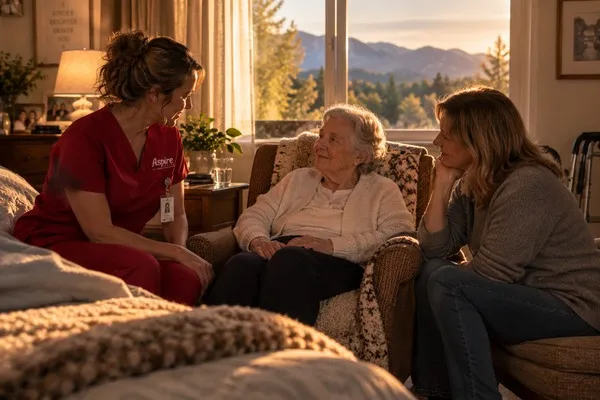
The nurse can be the nurse. The aide can be the aide. The social worker can be the social worker. The chaplain can be the chaplain.
And maybe that gives the daughter more time to be a daughter, the husband more time to be a husband, and the sister more time to simply be a sister.
When Should a Family Start Asking About Hospice?
Sooner than most families do. You do not have to wait until the final days of someone's life to start asking questions. It may be time to talk with a healthcare provider or a hospice about an evaluation if someone you love is experiencing:
Progressive decline
Repeated infections or hospitalizations
Increasing weakness
Significant weight loss
Worsening symptoms
Increasing dependence on others
A growing burden from treatment
An evaluation does not force anyone to elect hospice. Sometimes the first step is simply asking:
"Could hospice help us now?"
I wish my family had been able to ask that question sooner for my sister.
How Do You Choose a Hospice Before a Crisis?
Learn about the hospices in your community before you desperately need one. Ask each of them:
How do you respond after hours?
What support do you provide to caregivers?
How often will the nurse and the aide visit?
What do your social work and chaplain services look like?
How do you manage symptoms when they change suddenly?
What bereavement care do you offer the family?
Choose a hospice because you trust the care it provides, not simply because its name happens to be handed to you during a crisis.
Do Not Wait for the Crisis
I cannot go back and change what happened in that hospital room. I cannot give my sister the peaceful experience I wanted for her. But I can tell another family what I learned.
Do not wait for the crisis to start learning about hospice. Ask questions while there is still time to make choices.
Because the greatest benefit of starting hospice earlier isn't simply getting more hospice.
It is having enough time for hospice to actually become hospice.
And sometimes, it is giving the people who love the patient enough support that they can stop being caregivers for a moment and simply be family.
I would give anything to have had that opportunity with my sister.
Sources. Medicare.gov, "Hospice care" coverage page. Medicare Payment Advisory Commission, review of 2024 hospice data. Teno JM and colleagues, Journal of Pain and Symptom Management, 2007. Rickerson E and colleagues, Journal of the American Geriatrics Society, 2005. This article is general education, not medical advice.

