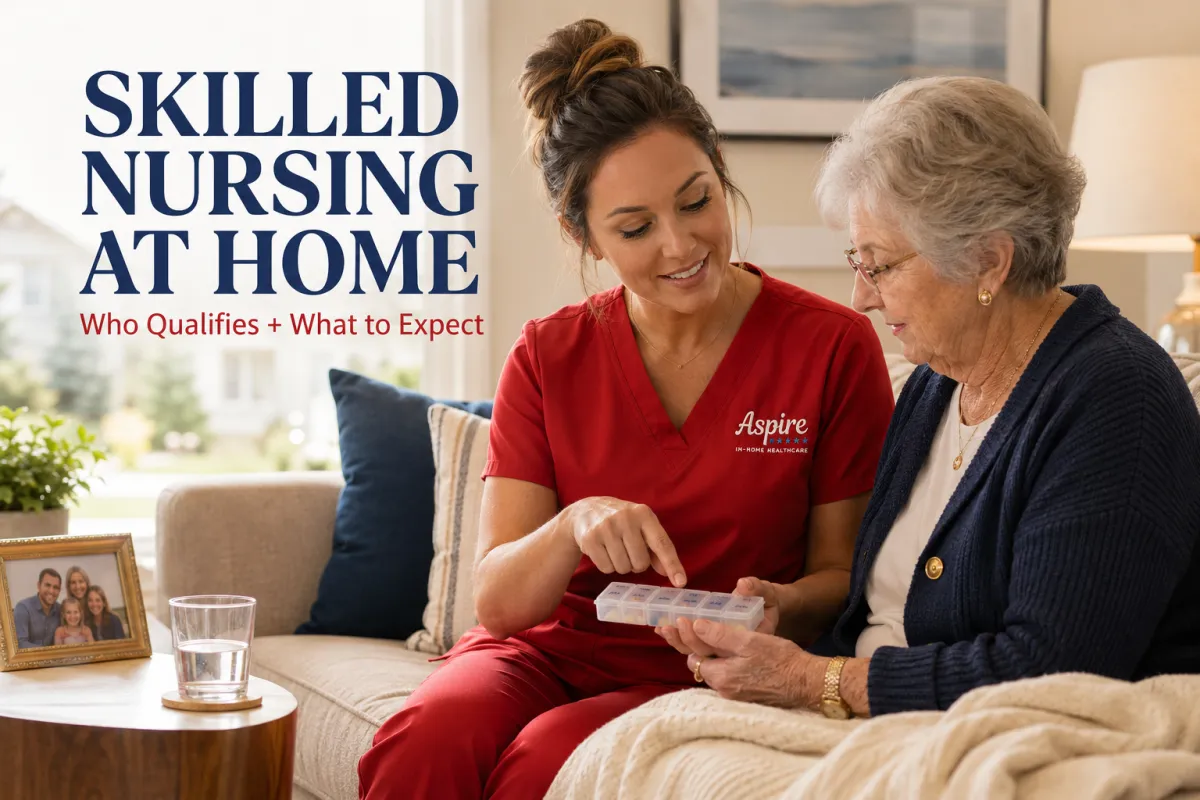
Skilled Nursing at Home. Who Qualifies + What to Expect
Skilled Nursing at Home: Who Qualifies and What Should You Expect?
Skilled nursing at home is available to patients who need medically necessary nursing care, meet Medicare's home health eligibility requirements, and can safely receive that care where they live.
For many families, the words skilled nursing immediately suggests a nursing home or rehabilitation facility, but skilled nursing does not always require leaving home.
A licensed nurse can provide many medically necessary services right where most patients would rather be anyway: at home.
I have been reminded of the value of that recently while helping my mother recover from a hip replacement. I have spent more than thirty years in healthcare, and somehow, I still find myself having the same kinds of conversations with my own mother that our home health nurses have with patients every day.
"What did the doctor tell you?"
"Are you taking that medication the way it was prescribed?"
"Are you following your precautions?"
And one of my favorites:
"Mom, if the instructions say once a day, three times a day isn't better."
Then there are the reminders that healing takes time. My mother has been frustrated that recovery hasn't happened as quickly as she expected, and I keep reminding her that a hip replacement is a major surgery and that our bodies don't necessarily recover at the same speed at 80 as they did at 40.
My mother has me. She has someone she can call who has spent decades in healthcare and can help her make sense of what she's experiencing.
A lot of families don't have that.
That's one of the reasons skilled nursing at home matters.
What Is Skilled Nursing at Home?
Skilled nursing at home is medical care provided by a licensed nurse through a home health agency, and it differs from non-medical home care or private-duty caregiving.
A home health nurse may assess a patient's condition, provide treatments, teach patients and caregivers how to manage an illness or medication regimen, communicate changes to the patient's healthcare provider, and identify potential problems that may need attention.
Depending on the patient's needs and plan of care, skilled nursing services may include:
Wound care and monitoring
Medication, education and management
Injections
IV or nutrition therapy
Monitoring a serious illness or unstable health condition
Disease-management education
Patient and caregiver teaching
Assessment after hospitalization or surgery
Monitoring complications or changes in condition
But I think a list like that only tells part of the story. A good home health nurse isn't simply coming into the home to complete a task; that nurse is looking at the whole patient.
Is the patient recovering safely?
Are the medications being taken correctly?
Is the wound healing?
Does the family understand what they should be watching for?
Has something changed that the physician or other healthcare provider needs to know about?
That clinical assessment, judgment, treatment, and teaching are what make skilled nursing skilled.
Who Qualifies for Medicare-Covered Skilled Nursing at Home?
Medicare doesn't cover home health simply because having a nurse come to the house would be convenient; specific eligibility requirements must be met.
Generally, a patient must:
1. Need skilled care
The patient must need part-time or intermittent skilled nursing, physical therapy, speech-language pathology services, or meet Medicare's requirements for continued occupational therapy. The care must be reasonable and necessary for the treatment of an illness or injury.
2. Be considered homebound
This is one of the Medicare requirements families misunderstand most often.
Homebound does not mean bedridden. It doesn't mean a patient is forbidden from leaving the house.
Generally, Medicare considers someone homebound when an illness or injury makes leaving home difficult, the person needs assistance or an assistive device to leave, leaving home is medically inadvisable, or leaving normally requires a considerable and taxing effort.
A homebound patient may still leave for medical care and certain infrequent or short absences without automatically losing homebound status.
3. Be under the care of a qualified healthcare provider
A physician or other Medicare-allowed practitioner must oversee the patient's care.
4. Have an established plan of care
Home health services must be ordered and provided according to an individualized plan of care established and periodically reviewed by the physician or allowed practitioner.
5. Receive care from a Medicare-certified home health agency
For Original Medicare to cover the home health benefit, the care must be provided by a Medicare-certified home health agency.
Aspire Home Health is a Medicare-certified home health agency serving patients and families in Utah.
What Does "Part-Time or Intermittent" Skilled Nursing Mean?
Let's clear up another common misunderstanding: a home health nurse does not move into your house.
Medicare home health is not 24-hour nursing care, housekeeping, or someone staying with Mom or Dad all day while the family is at work.
Skilled nursing is intermittent medical care provided according to the patient's clinical needs and plan of care.
One patient may need nursing visits for wound care and assessment after surgery; another may need monitoring and education after a hospitalization for heart failure; someone else may need help understanding new medications or learning how to manage a newly diagnosed condition.
The frequency and duration of visits depend on the patient's individual medical needs and continued eligibility.
The important distinction is this:
Home health provides skilled medical care in the home. It does not replace around-the-clock caregiving.
What Should You Expect When Home Health Begins?
At Aspire, I don't want our clinicians to walk into someone's home and see only the diagnosis written on the referral.
I want them to see the person.
What happened before we arrived?
What is keeping this patient from recovering?
What does the patient understand about the diagnosis?
Are the medications correct and being taken as prescribed?
Can the patient safely get to the bathroom?
Is the family overwhelmed?
What needs to happen to help this person become safer and more independent?
The initial home health assessment helps us understand the patient's medical condition, medications, mobility, safety, functional abilities, support system, and current challenges.
From there, the home health team works with the patient's healthcare provider to carry out the individualized plan of care.
Depending on the patient's needs, that team may include:
Skilled nurses
Physical therapists
Occupational therapists
Speech-language pathologists
Home health aides
Medical social workers
This is where home health can become especially powerful.
Consider someone like my mother returning home after major surgery.
A nurse may assess the incision, review medications, monitor pain, provide education, and watch for complications. A physical therapist may work on strength, balance, walking, and safe mobility, while an occupational therapist helps the patient safely return to everyday activities such as dressing, bathing, or preparing a meal.
Each clinician has a different role, but everyone should be working toward the same goal:
Helping the patient recover safely and becoming as independent as possible.
One of the Most Important Things a Home Health Nurse Does Is Teach
After more than thirty years in healthcare, I believe teaching is one of the most underappreciated things a great home health nurse does.
Hospitals are busy places. Patients are discharged with medication lists, follow-up appointments, new diagnoses, precautions, equipment, and pages of instructions.
Then they get home.
That's often when the questions begin. Lots of them.
Which medication did the doctor discontinue?
How often should this dressing be changed?
Is this swelling normal?
What happens if the blood pressure changes?
Am I supposed to be doing this once a day or twice?
When do we call the doctor?
What symptoms mean we need immediate medical attention?
Those questions are not signs that a family has failed. They're signs that healthcare is complicated.
A skilled home health nurse can help the patient and caregiver understand the plan of care, reinforce physician instructions, recognize warning signs, and learn how to safely manage between visits.
My goal for home health isn't to make families dependent upon us. Quite the opposite.
Good home health care should leave patients and caregivers more knowledgeable, more capable, and more confident than we started care with them.
Can Skilled Nursing at Home Help Prevent Hospitalizations?
For appropriate patients, skilled home health care can help identify changes before they become more serious.
A nurse may notice that a wound isn't healing as expected, that a medication isn't being taken correctly, or that a patient with heart failure has developed concerning symptoms. Someone recovering from surgery may show early signs of a complication, and a family caregiver may sense that Mom “just doesn't seem right” without knowing whether the change is important.
An experienced nurse can assess what's happening, educate the patient and caregiver, communicate concerns to the appropriate healthcare provider, and help coordinate the next step.
Not every hospitalization can or should be prevented. Sometimes the hospital is exactly where a patient needs to be.
But recognizing changes early gives the patient, family, and healthcare team an opportunity to respond before a manageable problem becomes a crisis.
That matters.
What Doesn't Medicare Home Health Cover?
Understanding what home health doesn't provide can save families a lot of confusion.
Medicare home health generally does not cover:
24-hour care in the home
Meal delivery
Homemaker services such as shopping or cleaning when those services are unrelated to the patient's plan of care
Personal or custodial care, such as bathing or dressing, when that is the only care the patient needs
Part-time or intermittent home health aide services may be covered when a patient is also receiving qualifying skilled home health services, and the aide care is included in the plan of care.
If Mom primarily needs someone to stay with her throughout the day, prepare meals, clean the house, provide companionship, or offer ongoing supervision, home health may not be the service you're looking for.
And that's okay.
Good healthcare isn't about trying to make every patient fit into one benefit.
It's about helping people find the right care for the need at the right time.
How Do You Know If It's Time to Ask About Skilled Nursing at Home?
You do not need to become an expert on Medicare before asking for help.
Consider talking with your physician, hospital discharge planner, or a Medicare-certified home health agency if you or someone you love:
Recently returned home from a hospital or rehabilitation stay
Is recovering from surgery
Has a wound requiring skilled assessment or treatment
Has experienced significant medication changes
Needs education about managing a new or worsening health condition
Is having difficulty safely managing a chronic illness
Has become weaker or less mobile following an illness or hospitalization
Is having increasing difficulty leaving home because of an illness or injury
Has a family caregiver struggling to understand increasingly complex medical needs
I think families sometimes hesitate to ask because they believe they should be able to manage everything themselves.
You don't get bonus points for figuring everything out by yourself.
If Mom's medications have become confusing, Dad's wound isn't healing, or you're worried that something has changed since coming home from the hospital, ask the question. You may discover that skilled home health care is exactly the support your family has been missing.
The Right Care at the Right Time
I have spent much of my career telling families that good healthcare isn't about getting the most care possible.
It's about getting the right care at the right time.
Sometimes that means a hospital.
Sometimes it means rehabilitation.
Sometimes it means outpatient care.
And sometimes the best place for skilled medical care is the place the patient most wants to be anyway.
Home.
There is something powerful about recovering there.
Your own bed.
Your own bathroom.
Your normal routines.
The people and things you love around you.
And when it is medically appropriate, skilled healthcare can come through the front door instead of requiring the patient to repeatedly leave home to find it.
At Aspire Home Health, we believe patients and families deserve to understand their options. If you are wondering whether you or someone you love may qualify for skilled nursing, physical therapy, occupational therapy, or other Medicare-covered home health services, you don't have to figure that out alone.
Ask.
A conversation can help determine whether home health is appropriate, what services may be needed, and what the next step should be.
Because sometimes the safest path home includes bringing a little healthcare home with you.

