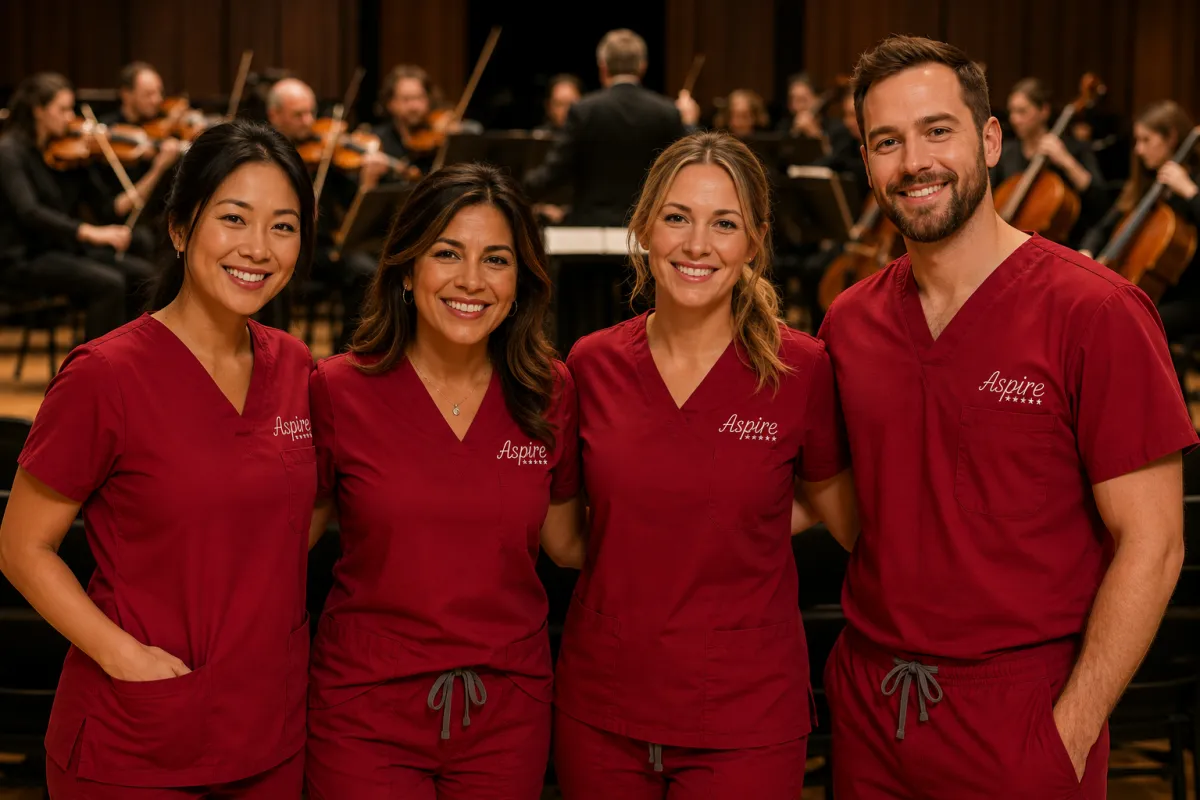
Ode to Joy: Why Great Care Feels Like a Symphony
Ode to Joy - A Hospice
Ode to Joy
A few weeks ago, Wendi and I were filming one of our social media videos.
If you've ever watched us together, you know the routine. Wendi tells the joke. I roll my eyes and wonder why I agreed to participate.
This particular joke was:
"What's Beethoven's favorite fruit?"
I shrugged.
"I don't know."
Wendi threw her arms into the air like a conductor and proudly announced:
"BA NA NA NAAAA!"
Terrible joke.
Naturally, we laughed anyway.
Later that evening, I found myself wondering why that melody was so instantly recognizable.
I looked it up.
The tune comes from Beethoven's Ninth Symphony, specifically the famous section known as Ode to Joy.
As I read about it, I learned that Beethoven composed this masterpiece while completely deaf. The music has become one of the most recognized pieces in the world, celebrating joy, unity, and the beauty of people coming together.
And then, unexpectedly, my mind traveled back several years.
A son had written a thank-you note to one of our hospice nurses, Janet, after his mother passed away.
Of all the words he could have chosen, he described her care as an Ode to Joy.
I have never forgotten that phrase.
At the time, I understood what he meant instinctively. But I don't think I fully appreciated its depth until now.
He wasn't describing a nurse.
He wasn't describing symptom management.
He wasn't describing a care plan.
He was describing a feeling.
An experience so meaningful that years later, he still struggled to find words for it.
The feeling that his mother was safe.
The feeling that she was comfortable.
The feeling that she was loved.
The feeling that she was not alone.
The feeling that somehow, amid one of life's most difficult moments, peace had entered the room.
That feeling didn't come from one person.
It came from an orchestra.
Janet wasn't responsible for every note.
She was the conductor.
She understood the score.
She knew when another discipline needed to enter and when a family simply needed a quiet presence.
Around her, each team member played their instrument, contributing their unique talents, gifts, and expertise.
Together, they created a beautiful gift.
A symphony of care.
As I reflected on that memory, another experience surfaced.
Several years ago, my son-in-law donated a kidney to his father.
My daughter was understandably anxious about the surgery, so I spent the morning at the hospital while the transplant team prepared both men for the procedure.
I remember watching the team move with fascination.
They were not frantic.
Not chaotic.
Instead, they were purposeful and confident.
Each person knew exactly what they were responsible for.
There was no confusion.
No wasted motion.
No ego.
Just professionals working together toward a common purpose.
As strange as it sounds, I felt comfort.
I felt peace.
And unexpectedly, I felt joy.
The feeling was remarkably similar to sitting in a concert hall listening to a magnificent symphony.
Every instrument entering at precisely the right moment.
Every musician understands their role.
Every note contributes to something greater than itself.
Perhaps I felt it deeply because music has always been part of my life.
As a child, I played both the piano and the violin.
I learned early that the most beautiful performances happen when musicians stop focusing on themselves and start focusing on the music.
That's where the magic lives.
And suddenly, a realization struck me.
This is exactly how I think about healthcare.
At Aspire, we often ask our team a simple question:
"What are you?"
And they respond:
"A FEELING."
People sometimes smile when they hear that.
But it may be one of the most important truths in healthcare.
Families rarely remember every medication adjustment.
They rarely remember every phone call or visit.
They never see the artistry of a visit note.
But they always remember how we made them feel.
Did they feel heard?
Did they feel respected?
Did they feel safe?
Did they feel cared for?
Did they feel less alone?
A family rarely notices every instrument in the orchestra.
They don't leave the concert discussing the third violin or the second clarinet.
They leave talking about how the music made them feel.
Healthcare is much the same.
Families may not remember every discipline involved in their care, but they never forget the feeling of exceptional care.
When every member of the care team plays their part well, something extraordinary happens.
The family stops hearing individual instruments.
They stopped noticing who entered on which note.
They stop focusing on job titles, disciplines, and tasks.
Instead, they experience the beauty of orchestrated care.
They experience trust.
They experience peace.
They experience joy.
And years later, long after the details have faded, that feeling is what remains.
That is why I have spent so much of my career building systems.
Some people believe systems remove compassion.
I believe the opposite.
Compassion requires structure.
Compassion requires coordination.
Compassion requires every member of the orchestra to know when to enter, when to support, and when to let another instrument lead.
Without structure, the music becomes noise.
With structure, the music becomes beautiful.
The son who described his mother's hospice experience as an Ode to Joy understood something profound.
Great care is not a collection of services.
Great care is a symphony.
Families don't remember the instruments.
They remember the music.
At Aspire, we often ask:
"What are you?"
And the answer is always the same:
"A FEELING."
Years ago, I thought that phrase was simply a reminder about customer service.
Today, I understand it differently.
The highest purpose of healthcare is not simply to treat people.
It is to create a feeling so meaningful that it remains long after the final note has been played.
Because great care is not a collection of services.
Great care is a symphony.
And families don't remember the instruments.
They remember the feeling of experiencing a beautiful symphony of care.

