How Home Health Helps Seniors Stay Independent | Aspire Utah
The Short Answer
Home health care helps patients stay independent longer by bringing skilled nursing, physical therapy, occupational therapy, and other medical services into their homes. These services can help people regain strength, manage chronic illnesses, reduce fall risks, and keep the abilities they need for everyday life.
But I think something important is missing from that explanation. Independence isn’t simply a medical measurement.
It’s personal.
It’s getting out of your favorite chair without asking for help. It’s walking to the kitchen to make a sandwich, taking a shower without worrying about falling, or sleeping in the bedroom you’ve shared with your spouse for decades.
Sometimes independence means doing everything yourself. Other times, it means having just enough help to keep living the life you want. After years in home healthcare, I’ve come to believe that protecting those everyday freedoms is one of the most meaningful things we can do for another person.
Why Does Staying Independent Matter So Much as We Age?
My father has made one thing abundantly clear: he wants to stay in his own home.
He has serious medical challenges, and his mobility has become more and more limited. But his determination to stay in familiar surroundings hasn’t changed one bit.
Recently, he had knee surgery. What was supposed to be an outpatient procedure turned into a five-day hospital stay, followed by time in a skilled nursing facility. My father wasn’t interested in staying there. In fact, he left against medical advice.
Was that the decision I would have preferred? No. Did it surprise me? Not particularly. My father has always had strong opinions about how he wants to live. I may not agree with every decision he makes, but I understand what’s underneath his determination.
He doesn’t want to lose control over his life.
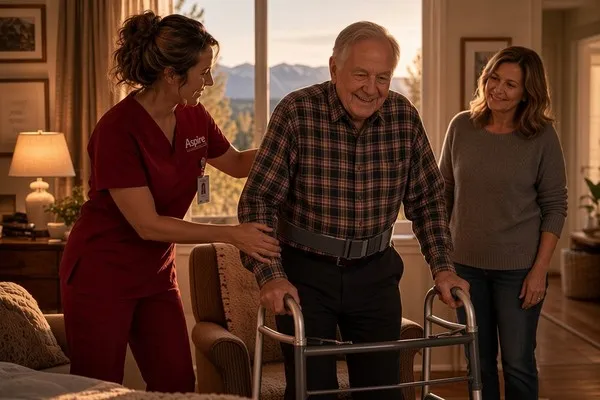
When Aspire began providing home health services after he returned home, something meaningful happened. He started moving around the house better. His medical problems didn’t magically disappear. He still needed help, and he still faced significant health challenges. But he regained some ability to move around his own home.
That matters. For my father, getting up and moving around his house isn’t just physical progress. It’s a little more control over his day. And that’s what independence often looks like.
Who Is on a Home Health Team?
Home health brings several kinds of skilled professionals into the home, each focused on a different part of everyday independence. Depending on a patient’s needs, the team may include:
Team member | How they help someone stay independent |
|---|---|
Physical therapist | Builds strength, balance, and safe walking for the real places a person moves: bed to bathroom, the favorite chair, the front steps. |
Occupational therapist | Makes everyday tasks like bathing, dressing, toileting, and simple meals safer and easier, often with small changes or adaptive equipment. |
Skilled nurse | Monitors chronic conditions, cares for wounds, teaches about medications and warning signs, and keeps the physician informed. |
Speech therapist | Helps with speech, swallowing, communication, and certain thinking and memory challenges. |
Medical social worker | Helps patients and families with emotional, practical, and community resource needs. |
Here’s a closer look at how the core services work.
How Does Physical Therapy at Home Help Someone Remain Independent?
One of the biggest threats to independence is losing the ability to move safely. A person who struggles to stand, walk, or keep their balance may gradually stop doing everyday activities. They might avoid walking to the bathroom because they’re afraid of falling, or stop going into the kitchen because standing is exhausting. Eventually, they may rely on someone else for tasks they once handled without a second thought.
Home physical therapy can help interrupt that cycle. A physical therapist evaluates a patient’s strength, balance, mobility, and safety, then builds a treatment plan around what that person needs to do in their own environment.
That last part is especially important. A patient doesn’t need to master a long hallway in a rehabilitation facility. They need to walk from their bedroom to their bathroom, get out of their favorite chair, and navigate the steps into their home. Physical therapy at home can focus on exactly those challenges.
For some patients, the goal is walking independently again. For others, it may be moving safely from a bed to a wheelchair or learning to use a walker correctly. And for someone like my father, even modest gains in mobility can make everyday life easier.
Progress doesn’t always mean returning to the way things were twenty years ago. Sometimes it means preserving the abilities someone still has today.
How Does Occupational Therapy Help With Everyday Independence?
Physical therapy focuses on movement, strength, and balance. Occupational therapy focuses on the activities that make up everyday life.
Think about how many things you do each morning without a second thought. You get out of bed, walk to the bathroom, brush your teeth, get dressed, and make breakfast. Now imagine how hard those tasks become when you’re weak, recovering from surgery, or living with a condition that affects your coordination.
An occupational therapist helps patients find safer, more manageable ways to get those tasks done. That may include teaching someone how to:
Get dressed while recovering from surgery.
Bathe more safely using the right equipment.
Get on and off the toilet safely.
Prepare simple meals without becoming exhausted.
Use adaptive tools when strength or mobility is limited.
Conserve energy throughout the day.
Sometimes a small change makes an enormous difference. A shower chair, a grab bar, or a different way of doing a task can help someone keep doing something that had become difficult or unsafe. Those improvements can also reduce how much hands-on help a family caregiver needs to give.
The goal isn’t to eliminate every need for help. It’s to help people do as much as they safely can for themselves.
How Does Skilled Nursing Help Patients Manage Chronic Illnesses at Home?
Independence depends on more than physical strength. A person may be able to walk around the house but struggle to manage diabetes, heart failure, medications, or complications after surgery. When medical conditions aren’t well managed, they can quickly get in the way of everyday life.
That’s where skilled nursing makes a difference. Home health nurses assess patients, monitor medical conditions, provide medically necessary treatments, and teach patients and caregivers how to manage health concerns. Depending on the patient’s needs, nursing care may include:
Monitoring changes in chronic medical conditions.
Providing wound care after surgery or injury.
Teaching patients how to take medications correctly.
Recognizing warning signs that need medical attention.
Helping patients and caregivers understand how to manage a disease.
Communicating important changes to the patient’s physician.
For someone living with congestive heart failure, for example, a nurse may teach which symptoms to report, such as worsening swelling, shortness of breath, or sudden weight changes. For a patient with diabetes, the focus may be on medications, blood sugar monitoring, and recognizing complications.
This teaching matters because patients and families spend far more time managing an illness on their own than they ever spend with a healthcare professional.
The more people understand their medical conditions, the better prepared they are to recognize problems and take part in their own care. That knowledge helps preserve independence.
Can Home Health Help Prevent Falls and Avoidable Hospitalizations?
Falls are one of the biggest worries families have when an older loved one starts struggling with mobility, and for good reason. A fall can lead to a fracture, a hospital stay, surgery, or a sudden loss of independence.
But preventing falls isn’t as simple as telling someone to be careful. A person may have weak legs, poor balance, dizziness, trouble using a walker, or obstacles throughout the home. Home health clinicians can spot those risks and help patients and families address them:
Physical therapists work on balance, strength, and safe walking.
Occupational therapists recommend changes to the home environment.
Nurses recognize medical issues that may contribute to weakness or dizziness and share those concerns with the treating provider.
Home health can’t prevent every fall or hospitalization. But catching problems early, improving safety, and helping patients manage their conditions can reduce some avoidable complications.
Preventing a setback can be just as important as making progress. For an older adult who is already struggling, another hospital stay can mean more weakness, disrupted routines, and a longer road back.
Sometimes preserving independence means helping someone avoid losing more of it.
Does Home Health Help Family Caregivers, Too?
Absolutely, and I think this is one of the most overlooked benefits of home health.
When someone becomes ill or loses mobility, the responsibility often falls on a spouse, an adult child, or another family member. Suddenly, that person is helping with medications, transportation, meals, bathing, appointments, and decisions they may not feel prepared to make.
I’ve seen this professionally for years, and I’m living it now with my own family. My mother has taken on tremendous responsibility helping my father with his daily needs, even while recovering from her own hip replacement surgery this past June. As she puts it, “I need to keep him happy.” Like so many family caregivers, she wants to help him stay at home.
But wanting to care for someone doesn’t automatically give you the physical strength, medical knowledge, or resources to meet every need. Home health professionals can teach caregivers safer techniques, explain medical instructions, and help them recognize when something needs attention. For example:
A physical therapist might teach a spouse how to help with transfers without putting either person at risk.
A nurse might explain which symptoms call for a phone call to the physician.
An occupational therapist might suggest equipment that makes bathing or dressing easier.
Those are practical forms of support, and when caregivers feel better prepared, the whole household benefits.
Keeping someone independent should never mean their family has to do everything alone.
Can Medicare Cover Home Health Even if Someone Isn’t Getting Better?
Yes, and this is something I wish more families understood.
Medicare does not always require a patient to improve to qualify for covered skilled home health services.
When the other eligibility requirements are met, Medicare may cover skilled nursing or therapy needed to maintain a person’s current condition or to prevent or slow further decline. That distinction is especially important for people living with chronic or progressive illnesses.
A person with Parkinson’s disease, for example, may need skilled therapy to maintain mobility or slow the loss of certain abilities. Someone with a complicated chronic condition may need skilled nursing assessment and management even when a full recovery isn’t expected.
Coverage depends on whether the services are medically necessary and require the skills of a qualified professional, not simply on whether the patient is getting stronger. Routine exercise or personal care that can safely be done without a skilled clinician isn’t automatically covered. But a lack of improvement, by itself, is not a reason to deny otherwise qualifying skilled care.
Sometimes maintaining someone’s abilities is a meaningful medical outcome. And sometimes slowing a decline is what helps someone stay at home longer.
Who Qualifies for Medicare Home Health Care?
Medicare generally covers home health services when the patient (see Medicare.gov’s home health services page):
Is under the care of a physician or other allowed practitioner.
Has an established plan of care that is reviewed regularly.
Needs qualifying intermittent skilled nursing or therapy services.
Is considered homebound under Medicare’s rules.
Receives care from a Medicare-certified home health agency.
Being homebound doesn’t mean someone can never leave the house. It generally means that leaving home takes considerable effort or assistance because of illness or injury. A person can still leave for medical appointments and certain other permitted activities.
For eligible patients with Original Medicare, covered home health services generally have no out-of-pocket cost, although charges may apply for durable medical equipment. If your loved one has a Medicare Advantage plan, check coverage and costs with the plan.
It’s also important to know what Medicare home health does not ordinarily provide. It doesn’t cover around-the-clock care, meal delivery, or housekeeping unrelated to the skilled care plan, and it doesn’t cover personal care alone when there’s no qualifying skilled need.
Home health is a medical benefit, not a replacement for full-time caregiving.
What Are the Signs That an Older Parent May Need Home Health?
Sometimes families recognize the need for help after a hospital stay or surgery. Other times, the changes creep in gradually. You may notice your parent walking more slowly, struggling to get out of a chair, becoming less steady, or having trouble keeping medications straight. Perhaps they’ve stopped showering regularly because getting in and out of the tub has become hard. Maybe they’ve started skipping activities they once enjoyed because they’re afraid of falling or getting worn out.
These changes deserve attention.
Signs it may be time to ask about home health
A recent hospital stay, surgery, or significant illness.
Increasing weakness or difficulty walking.
Frequent falls or near-falls.
Difficulty bathing, dressing, or moving safely around the home.
Complicated medication or medical management needs.
Wounds that need skilled treatment.
A chronic illness that has become harder to manage.
A caregiver who needs training to help a loved one safely.
Not everyone experiencing these changes will qualify for Medicare home health, but they’re all good reasons to ask a healthcare professional for an evaluation. And you don’t have to wait until someone falls or ends up in the hospital to start asking questions.
Key Takeaways
Home health brings skilled nursing and therapy into the home to help people regain or keep the abilities that matter most to them.
Therapy at home focuses on the real places and tasks of daily life: the bathroom, the favorite chair, the front steps.
Medicare may cover skilled care to maintain abilities or slow decline, not only to help someone improve.
Home health supports family caregivers with training and guidance, but it doesn’t replace full-time caregiving.
Accepting a little help is often how people stay independent longer.
Frequently Asked Questions About Home Health and Independence
Can home health help an elderly parent stay at home longer?
Yes. Home health may help eligible older adults maintain mobility, manage medical conditions, improve safety, and preserve everyday abilities. These services support the goal of staying at home, although results depend on the person’s health and the caregiving support available.
What is the difference between home health and a caregiver?
Home health provides qualifying skilled medical services, such as nursing and therapy. A personal caregiver generally helps with everyday activities like bathing, dressing, meals, and companionship. Many patients benefit from both.
Can physical therapy be provided in my parent’s home?
Yes. Medicare-covered home health physical therapy may be available when a patient meets the eligibility requirements and has a medically necessary need for skilled therapy.
Does someone need to be completely unable to walk to qualify for home health?
No. Medicare’s homebound requirement doesn’t mean a patient must be bedridden or unable to walk. A person may qualify when leaving home takes considerable and taxing effort or assistance and the other requirements are met.
Can home health help someone with heart failure or diabetes?
Yes. Patients with chronic illnesses may qualify for skilled nursing or therapy when their medical needs and homebound status meet Medicare requirements. A diagnosis alone doesn’t guarantee coverage.
How long can someone receive home health care?
There is no fixed limit on how long an eligible patient can receive Medicare-covered home health services. Continued coverage depends on ongoing medical necessity, eligibility, and the required plan-of-care reviews.
Can home health help prevent nursing home placement?
Home health may help some patients stay safely at home by improving or maintaining function and supporting medical management. It can’t guarantee that nursing home care will never be needed, especially when someone requires extensive supervision or help throughout the day.
Keep reading: Physical Therapy at Home and Medicare and Home Health vs. Hospice: What’s the Difference?
Independence Isn’t About Doing Everything Alone
The older I get, and the more I live caregiving within my own family, the more I realize that independence means different things to different people. For one person, it’s walking to the mailbox. For another, it’s making breakfast without help. For my father, it’s moving around his own house and continuing to live where he wants to be.
And sometimes, the very thing that helps someone stay independent is accepting a little assistance.
I think that’s a hard idea for many of us. We grow up believing independence means doing everything ourselves. But there comes a point when refusing help can put the things we value most at risk.
A person who refuses a walker because they don’t want to look dependent may be setting themselves up for a fall. Someone who skips physical therapy because they think they should recover on their own may miss the chance to move better. And a family trying to manage complicated medical needs without professional guidance can quickly become overwhelmed.
Accepting help isn’t losing independence. Sometimes it’s how we preserve it.
My father’s home health experience has reminded me of that. He still has significant medical challenges. Home health hasn’t solved every problem, and it was never meant to. But helping him move around his own home more safely has given him something he values tremendously: a little more freedom, a little more control, and another chance to live life on his terms.
That’s what I believe exceptional home health care should strive for. Not simply adding years to someone’s life, but helping them keep the abilities that make those years meaningful.
Because staying independent isn’t always about how much you can do without help. Sometimes it’s about having the right help, so you can keep doing what matters most.
Could Home Health Help You or Someone You Love Stay Independent?
At Aspire Home Health, Hospice, and Palliative Care, we believe care should begin with understanding what matters most to each patient. Our home health team provides skilled nursing, physical therapy, occupational therapy, speech therapy, and other qualifying services to help patients recover, maintain their abilities, and manage medical conditions in the comfort of home. We serve families throughout Salt Lake, Davis, Weber, and Utah counties.
Call Aspire at 801-292-0296 or visit AspireUtah.com to learn whether home health may be right for you or your loved one.
About the Author: Kris Carter is the founder and CEO of Aspire Home Health, Hospice, and Palliative Care. She has worked in healthcare since 1993, has led healthcare organizations since 2002, and served six years on Utah’s healthcare facilities committee by appointment of the Governor. Her writing draws on that experience and on more than 45 years as a family caregiver.

